Fleetstock Academy
Modern Industrial Technologies Series
Topic No. 0011
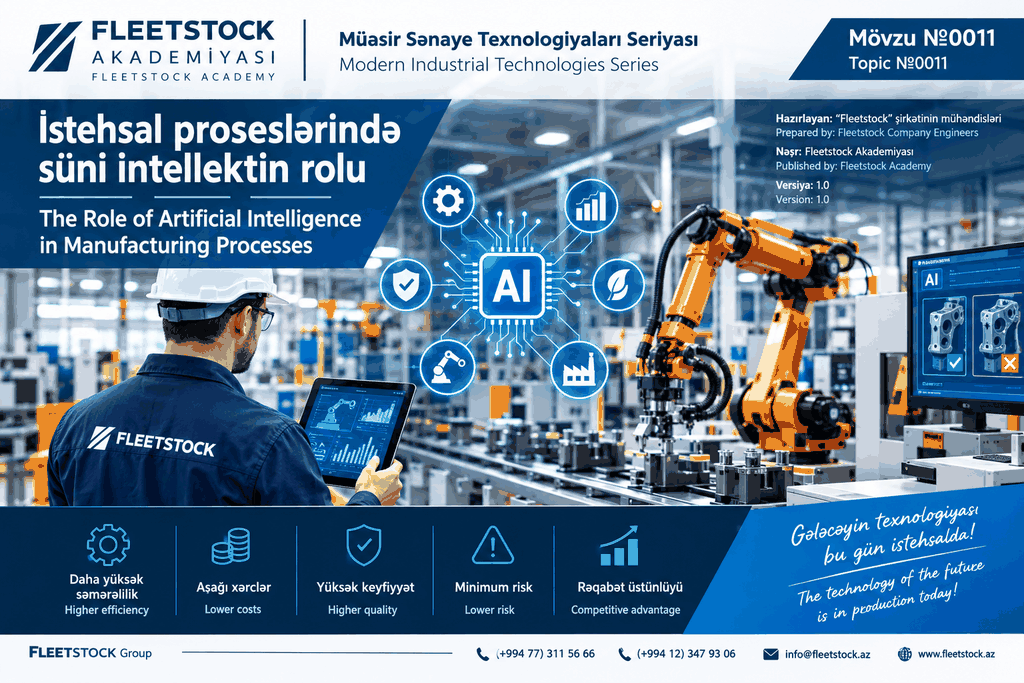
The Role of Artificial Intelligence in Manufacturing Processes
Prepared by: Engineers of Fleetstock Company
Published by: Fleetstock Academy
Version: 1.0
Foreword
The modern industrial environment is rapidly undergoing digital transformation, and manufacturing processes are increasingly being managed through intelligent systems rather than traditional methods. At the heart of this transformation is Artificial Intelligence (AI).
Artificial Intelligence refers to a group of technologies and systems capable of analyzing large volumes of data, learning from information, drawing conclusions, and supporting or making optimal decisions.
The implementation of AI technologies in manufacturing plays a significant role in improving operational efficiency, reducing costs, enhancing product quality, and minimizing risks. In particular, Artificial Intelligence has become a strategic management tool in areas such as sensor data processing, equipment condition monitoring, quality control, and production planning.
Purpose and Objectives
Purpose
The purpose of this topic is to systematically explain the application opportunities, economic impact, risks, challenges, and future development prospects of Artificial Intelligence in manufacturing processes.
Objectives
* Identify the main areas where Artificial Intelligence can be applied in manufacturing;
* Demonstrate how AI systems work through practical examples;
* Evaluate the advantages of AI in quality control and maintenance processes;
* Analyze its impact on economic efficiency;
* Present the implementation stages in a logical sequence;
* Identify potential risks and methods for reducing them;
* Summarize future prospects and development trends.
1. Areas of Artificial Intelligence Application in Manufacturing
1.1. Process Optimization
Artificial Intelligence analyzes data collected from sensors, ERP systems, and production lines. Based on this analysis, deviations in processes, energy losses, and factors affecting productivity can be identified at an early stage.
Practical Example
A temperature increase of 3% above the normal operating range on a production line may negatively affect product quality. An AI system can detect this deviation in real time and initiate automatic adjustments.
Results
* Energy consumption is reduced;
* The number of defective products is minimized;
* Production processes become more stable and efficient.
1.2. Predictive Maintenance
Traditional maintenance generally follows two main approaches:
* Planned maintenance — performed according to a fixed schedule;
* Corrective maintenance — performed after equipment failure occurs.
Artificial Intelligence introduces a more advanced approach known as condition-based and predictive maintenance. This model continuously monitors the actual condition of equipment and identifies potential failures before they occur.
Parameters Analyzed
* Vibration levels;
* Temperature;
* Sound frequency;
* Energy consumption.
Practical Example
The vibration level of an electric motor rises by 8% above its normal operating range. The AI system analyzes the trend and predicts a possible failure within the next two weeks. A maintenance inspection can therefore be scheduled before a breakdown occurs.
Advantages
* Unexpected downtime is reduced;
* Maintenance and repair costs decrease;
* Equipment service life is extended.
1.3. Automated Quality Control
AI-powered computer vision systems analyze products using cameras and intelligent image-processing technologies. These systems can identify defects at high speed and with a level of consistency that may exceed traditional manual inspection.
Comparison
Criterion Traditional Inspection AI-Based Inspection
Speed Moderate Very High
Human Error Higher Minimal
Accuracy 85–90% Up to 97–99%
Continuity Limited 24/7 Operation
Practical Application
On a packaging line, an incorrect or damaged label can be automatically detected, and the defective product can be removed from the production line.
This approach helps ensure that products reach the market with fewer defects while also reducing rework and waste-related costs.
1.4. Production Planning and Demand Forecasting
Artificial Intelligence can analyze sales history, seasonal changes, market trends, and other relevant data to forecast future demand more accurately.
Practical Example
Demand for a particular product increases by 35% during the summer season. The AI system can forecast this increase in advance, allowing the company to adjust production capacity and optimize inventory levels.
Results
* Overproduction is reduced;
* Inventory shortages are prevented;
* Logistics operations become more efficient.
1.5. Robotic Manufacturing Systems
AI-controlled robots provide high levels of precision, consistency, and efficiency in manufacturing processes.
These robots can perform operations such as:
* Welding;
* Assembly;
* Packaging;
* Sorting and classification.
Advantages
* Workplace safety is improved;
* Production speed increases;
* Consistent quality standards are maintained.
2. The Economic Impact of Artificial Intelligence
The implementation of Artificial Intelligence produces important results not only from a technical perspective but also from an economic one.
Through automation and optimization, manufacturing companies can achieve better results while using fewer resources.
2.1. Cost Reduction
The implementation of AI can improve several important economic indicators.
Economic Impact
Indicator Expected Improvement
Energy Costs Reduction of 10–20%
Defective Products Reduction of 15–30%
Equipment Downtime Reduction of 25–40%
These benefits can be particularly significant in industries with high energy consumption.
For example, when real-time optimization is implemented, equipment such as compressors, electric motors, and heating systems can operate according to actual production requirements rather than running unnecessarily.
2.2. Increased Productivity
Automation and process optimization can lead to:
* Higher production speeds;
* Reduced dependence on manual labor;
* Increased production capacity within the same operating period.
As a result, companies can respond more quickly to market demand and gain a stronger competitive advantage.
3. Stages of Artificial Intelligence Implementation
The successful integration of Artificial Intelligence into a manufacturing environment should be carried out gradually and systematically.
Each stage should build on the information and results obtained from the previous stage, increasing the reliability and sustainability of the overall system.
Implementation Stages
Stage Description Expected Result
Analysis of Existing Processes Evaluation of production flows, equipment, and data sources Identification and mapping of key problems
Data Collection and Structuring Integration of sensor, ERP, MES, and SCADA data into a structured system A reliable foundation for AI models
AI Model Development Development of forecasting and decision-making algorithms Automated analysis and intelligent insights
Testing Stage Pilot testing on selected production lines and comparison of results Reduced implementation risks
Full Integration and Monitoring Connecting the model to production systems and continuously monitoring performance Continuous optimization
The correct implementation of these stages increases the probability of project success and minimizes unexpected technical challenges.
4. Risks and Challenges
The implementation of Artificial Intelligence may involve several technical, organizational, and financial challenges.
Identifying and managing these risks in advance is essential for ensuring the long-term sustainability of an AI project.
Risks and Solutions
Risk Impact Preventive Measure
High Initial Investment Increases project startup costs Phased implementation and ROI analysis
Shortage of Qualified Personnel Makes effective system operation more difficult Training and professional certification
Cybersecurity Risks May lead to data breaches and system disruptions Strong IT infrastructure and security policies
Poor Data Quality Reduces the accuracy of AI models Data cleaning, validation, and standardization
Addressing these challenges requires employee training, a strong IT infrastructure, and effective data management.
Data quality is particularly important because the accuracy and reliability of AI models depend directly on the quality of the information used to train and operate them.
For this reason, proper data collection, validation, and standardization should be considered essential requirements during the initial stages of implementation.
5. Future Perspectives
In the future, manufacturing systems will become increasingly intelligent, flexible, and autonomous.
As Artificial Intelligence technologies continue to develop, the following areas are expected to become more widespread:
* Fully automated production lines;
* Self-regulating manufacturing systems;
* Reduced need for human intervention;
* Artificial Intelligence becoming a central component of decision-making;
* Wider implementation of digital twins and adaptive control systems.
These developments will enable companies not only to increase productivity but also to adapt more quickly to changing market conditions and customer demands.
Conclusion
Artificial Intelligence plays a fundamental role in the transformation of modern manufacturing processes.
Its implementation can:
* Increase operational efficiency;
* Reduce costs;
* Improve product quality;
* Minimize operational risks;
* Create a sustainable competitive advantage.
In modern industry, the adoption of Artificial Intelligence is increasingly becoming not simply an option, but a strategic necessity.
When manufacturing companies adopt AI as a strategic management and decision-support tool, they can achieve greater technical reliability, economic efficiency, operational flexibility, and long-term sustainability.
The technology of the future is no longer separate from manufacturing—it is becoming an integral part of production today.
Contact Us
Mobile: (+994 77) 311 56 66
Tel: (+994 12) 347 93 06
E-mail: info@fleetstock.az
Web: www.fleetstock.az
Fleetstock Group